
Iran (Persian)
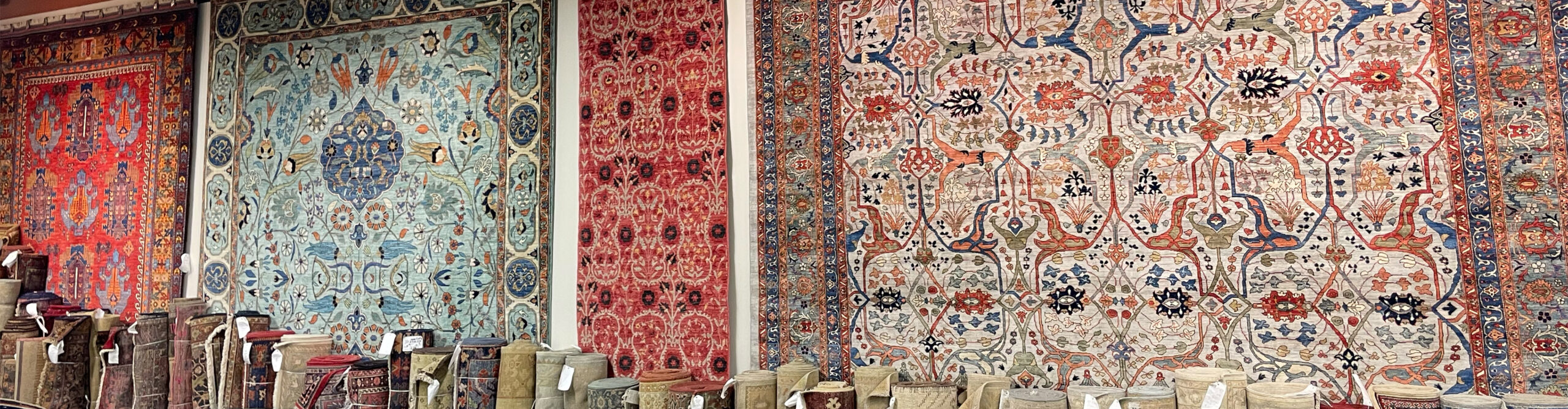
Persian Rugs From Iran
Hand-knotted rugs from Iran, often called Persian rugs, are world-renowned for their exquisite craftsmanship and intricate designs. Woven primarily with wool, silk, or a blend, they use the Persian (asymmetric) knot, allowing for fine detailing and durability. Designs feature floral motifs, medallions, arabesques, and scenes from nature or mythology, rendered in rich natural dyes—reds, blues, saffrons, and ivories. Each region, like Tabriz, Isfahan, or Kashan, boasts distinct styles, reflecting local traditions and artistry.
Their history dates back over 2,500 years, with roots in ancient Persia (modern Iran). The Achaemenid Empire (550–330 BCE) used rugs as luxury items, a tradition elevated under the Safavid Dynasty (1501–1736), when Persian rug-making peaked as a court art. The 16th-century Ardabil Carpet exemplifies this golden age, showcasing unparalleled skill. Rugs served as floor coverings, wall hangings, and trade goods along the Silk Road, spreading Persian culture globally. Despite invasions and political shifts, the craft endured, with 19th-century European demand sparking a revival. Today, Persian rugs remain symbols of heritage and artistry, blending ancient techniques with timeless elegance, prized by collectors and decorators worldwide.
Distinguishable By Region
Located in northwest Iran, Bijar is known for producing rugs that are exceptionally stiff, heavy, thick, and durable. The rugs are beaten during the weaving process to make the rugs denser, which accounts for the durability. This weave serves as the primary means of identification of a Bijar rug, as the patterns and colors used vary greatly.
Heriz, a village in northwest Iran, is known for its carpets featuring bold, geometric patterns and designs containing a dominant center medallion. Luxuriant reds, blues, greens, and yellows set against ivory are typical of Heriz rugs. Highly stylized floral motifs, stepped center medallions, and double outlining, a design technique where the main aspect of the rug is separated from the field by two lines in different colors, set these rugs apart from other Persian rugs.
Serapi Rugs are essentially a subset of Heriz rugs, but they’re considered a higher-quality, older, and more refined version, typically dating to the 19th and early 20th centuries. The term “Serapi” is a Western trade name, possibly derived from “Sarab” (a nearby village) or a misnomer. They feature similar geometric medallion designs but with more open, spacious layouts and softer, richer colors—often aged naturally over time. Serapi rugs are prized as antiques, with coarser yet elegant weaves, and command higher prices due to their rarity and historical appeal.
In short, all Serapi rugs are Heriz in origin, but not all Heriz rugs qualify as Serapi. Serapi represents an elite, vintage category within the broader Heriz style, distinguished by age, finesse, and market lore.
Kashan, situated in north central Iran, yields some of the very finest Persian rugs and carpets available. A center of silk production since the 16th century, many of the best Persian silk rugs have been attributed to Kashan, although high-quality wool carpets are produced there as well, at least since the end of the 19th century. These rugs often contain elongated center medallions and corner spandrels, with little to no blank space. All-over patterns are not uncommon either, with repeated floral, vase, vine, scroll, and leaf designs contained within a central border within two smaller contrasting bands.
The city of Tabriz in northwest Iran is considered one of the most important rug-weaving centers in Iran and is home to some of the most skilled and artistic weavers in the world. Always handmade, the patterns, colors and the large number of hues used are characteristics of a Tabriz rug. The palette used may range from dark red and navy blue to ivy, tan, soft green and other pastels. These rugs are known for the large number of colors used in a single piece. They usually have intricate patterns, with small and complicated details. Most Tabriz rugs have a medallion in the middle and quarters of medallion at the corners, but there are some which may have geometric, simpler patterns where floral motifs are predominant, with vases, palmettos and hunting scenes near the edge.
One of the largest, most important centers for Persian rug-weaving, Isfahan is in central Iran and was once the capital of Persia. Classic Isfahan rugs date back to the Safavid Dynasty, which lasted from 1501 to 1736, but the city is still the site of major production, with these carpets being some of the most highly sought after around the world. Rugs produced in Isfahan usually display ivory backgrounds against blue, rose, magenta, saffron, and indigo motifs that form symmetrical, balanced designs. Center medallions are very common, as are arabesque tendrils, vines, palmettos, and cloud bands.
Rugs from Malayer, a town in northwest Iran, are typically very thick and vary widely in pattern, including both medallion and allover designs, although patterns do tend to be somewhat abstract or geometric. Boteh, a paisley design and herati, a flower centered in a diamond with curving leaves surrounding the diamond, are both common, as is the use of empty space. Blue, red, cream, and orange are frequently seen in these rugs.
Centrally located, the city of Yazd is known for high-quality, durable carpets. These rugs generally showcase a single center medallion with a strong red background and brownish border. Pink, green, and khaki are also common.
Nain, a small city in central Iran, and its surrounding areas began producing rugs relatively recently, only in the 1930s. Nain rugs are usually made of wool with silk highlights in dark blue, beige, or cream colors. Central medallions and bird motifs and floral designs and tendrils are highly characteristic. Nain was home to famous rug weavers and designers Habibian and Reza Jafari Naini, whose rugs are beautiful, frequently copied, and highly valuable.
Produced in the holy city of Qum located in north central Iran, these rugs can date back to the early 20th century and feature thin piles and mostly silk construction. Qum rugs can utilize a variety of styles, but usually feature small allover designs with curved lines. The colors used are generally bold, including red, blue, and ivory.
Senneh rugs come from the town of Sanandaj in northwest Iran, where the dialect spoken among weavers is called Senneh. These carpets come in a range of both allover and medallion patterns that are often imitations of Bijar or Tabriz styles and it is their weave that makes them unique. Using very fine mountain wool, Senneh rug weavers create very thin, fine carpets. Precise, crisp, often geometric designs usually characterize these rugs, along with varied, rich colors.
Although Shiraz is well-known for making wine, the southwestern Iranian city also has a thriving carpet industry. Unlike other cities, however, Shiraz rugs tend to be made by home weavers instead of in large factories. These domestic artisans usually sell their pieces at the main bazaars in Shiraz, where traders will collect a sizeable group from many independent weavers to export as a group. These rugs generally feature geometric patterns, pole medallions, or diamond-shaped lozenges as the primary motif, with borders consisting of smaller bands around a larger band with various leaf designs. Commonly used colors include numerous shades of red and brown.
The city of Mashhad is one of the oldest centers of carpet weaving in the world and is still home to extensive carpet manufacturing. Curved lines, central medallions, corner floral designs, and densely decorated backgrounds are characteristic of Mashhad carpets. Common colors used include dark red, blue, and khaki. These rugs are constructed from some of the highest-quality wool in Iran and are usually large in size.